Test a Short Brand Out Loud Before You Design It
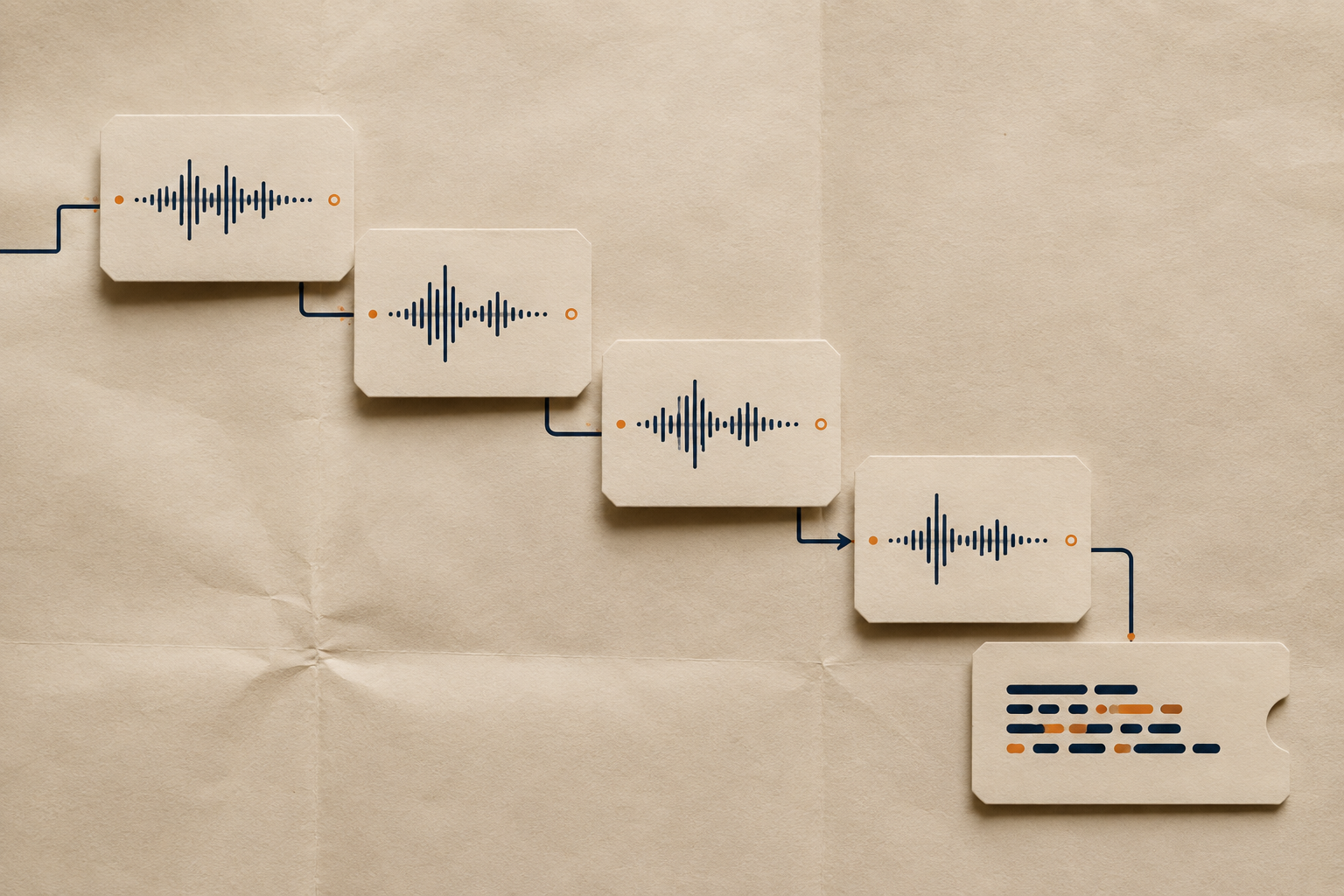
Why spoken tests catch different problems
Brand reviews usually happen on screens. A short name appears in a large font beside a carefully chosen color, so spelling feels obvious. Customers may first encounter it in a conversation, podcast, video, voicemail, event introduction, or support call. In those moments the visual system cannot repair an unclear sound.
A spoken test isolates that behavior. It asks whether someone can hear the name, repeat it, type it, and connect it with the right product. The goal is not to eliminate every variation. It is to identify predictable friction before the team spends on identity, signage, domains, and launch material.
Prepare neutral test sentences
Write five sentences that resemble real use: I tried NAME yesterday, send the plan through NAME, our team uses NAME for outings, visit NAME dot co, and support is handled inside NAME. Include the name at the beginning, middle, and end. Avoid sentences that reveal the spelling through a pun.
Record one speaker in a quiet room and another in an ordinary call environment. Keep volume consistent. Do not overpronounce the candidate. If the team normally expects an international audience, include speakers with relevant accents and avoid treating one pronunciation as defective merely because it differs from the founder's.
Run listen and type
Play each sentence once and ask participants to type the name and full web address. Do not show options. Record exact answers, hesitation, and requests for repetition. A typed result reveals whether the sound maps naturally to the intended spelling and whether listeners default from .co to .com.
Repeat the exercise after an unrelated task. Delayed transcription is closer to a referral where the listener does not act immediately. Compare the errors. If one alternate spelling dominates, the team needs a clear mitigation or a different name.
Reverse the direction
Next, show the written name without audio and ask participants to say it. Record the first pronunciation. A candidate can be easy to hear but ambiguous to pronounce, which affects meetings, onboarding, and customer advocacy. Test lowercase, title case, and the actual domain form.
Do not correct the participant until the attempt is complete. Ask what cues drove the pronunciation. A visual split, capital letter, or unfamiliar letter pair may create an interpretation the logo concept hides. Those observations can inform typography if the name remains viable.
Measure category expectation
After hearing the sentence, ask what the product probably does and how confident the participant feels. The surrounding sentence should provide some context but not a full explanation. Group answers into useful categories instead of declaring each guess right or wrong.
A travel planner may tolerate guesses such as local discovery, outings, or mobility. A regulated financial product may need much tighter expectation. Decide the acceptable range before reviewing results. This prevents the team from explaining away every surprise because it already loves the candidate.
Test referrals and interruptions
Have one participant hear the name, then tell it to a second participant who was not present. This telephone-style test is imperfect but useful for referral behavior. Add a short interruption between hearing and repeating. Observe which part survives: sound, spelling, category, or web address.
For support scenarios, place the name beside an order number or personal name. Short brands can be mistaken for ordinary words in a dense sentence. A simple verbal pattern such as brand, pause, dot co may improve accuracy. Document the pattern for sales and support teams.
Include international and accessibility context
A global team should test sounds that may be difficult or carry unintended meanings in key languages. This is research, not a quick translation check. Use qualified local reviewers for markets that matter and keep a record of regional findings. Do not claim universal pronunciation from a small sample.
W3C material on pronunciation and accessible names is a reminder that visible and spoken labels need to align. Voice interfaces, screen readers, captions, and dictation can expose inconsistencies. Test how common tools pronounce and transcribe the name, then provide text alternatives where needed.
Score patterns rather than opinions
Create a table for first-hear spelling, full-domain accuracy, first-read pronunciation, delayed recall, category fit, and serious negative associations. Record both the percentage and the sample size. Small tests guide design decisions; they do not produce population truth.
Separate fixable issues from structural ones. A .co reminder can be repeated in launch material. A consistently misheard core syllable is harder. Typography can clarify reading but cannot repair audio. Legal conflict requires its own clearance path.
Decide before visual polish
Run the test while candidates are still cheap to change. If the result is promising, use the observed pronunciation to guide spacing, capitalization, and motion. Then repeat a smaller test with the final wordmark to ensure the design did not introduce a new reading.
The best next step is a blinded session with people outside the project. Give them realistic sentences, wait before asking for recall, and collect exact responses. A short brand should save explanation over time. Testing it out loud shows whether it begins with that advantage or asks the audience to do extra work.
Run the same task with one person who must use the name operationally, such as a support agent, salesperson, or event host. Ask that person to repeat it during a realistic interaction rather than a branding interview. Operational speech often exposes problems that a quiet recall test misses, including awkward email dictation, uncertain capitalization, and the need to explain the extension twice. Save the phrases that work naturally so the launch team can use them consistently.
Keep the raw responses, not only the score. Exact misspellings and category guesses help writers prepare clearer introductions, support teams recognize likely errors, and designers avoid visual choices that reinforce the wrong reading. Repeating the test after launch can show whether real product context is teaching the name.
Explore goso.co.
The domain and completed website package are available for acquisition. Terms are discussed privately.
Inquire about goso.co